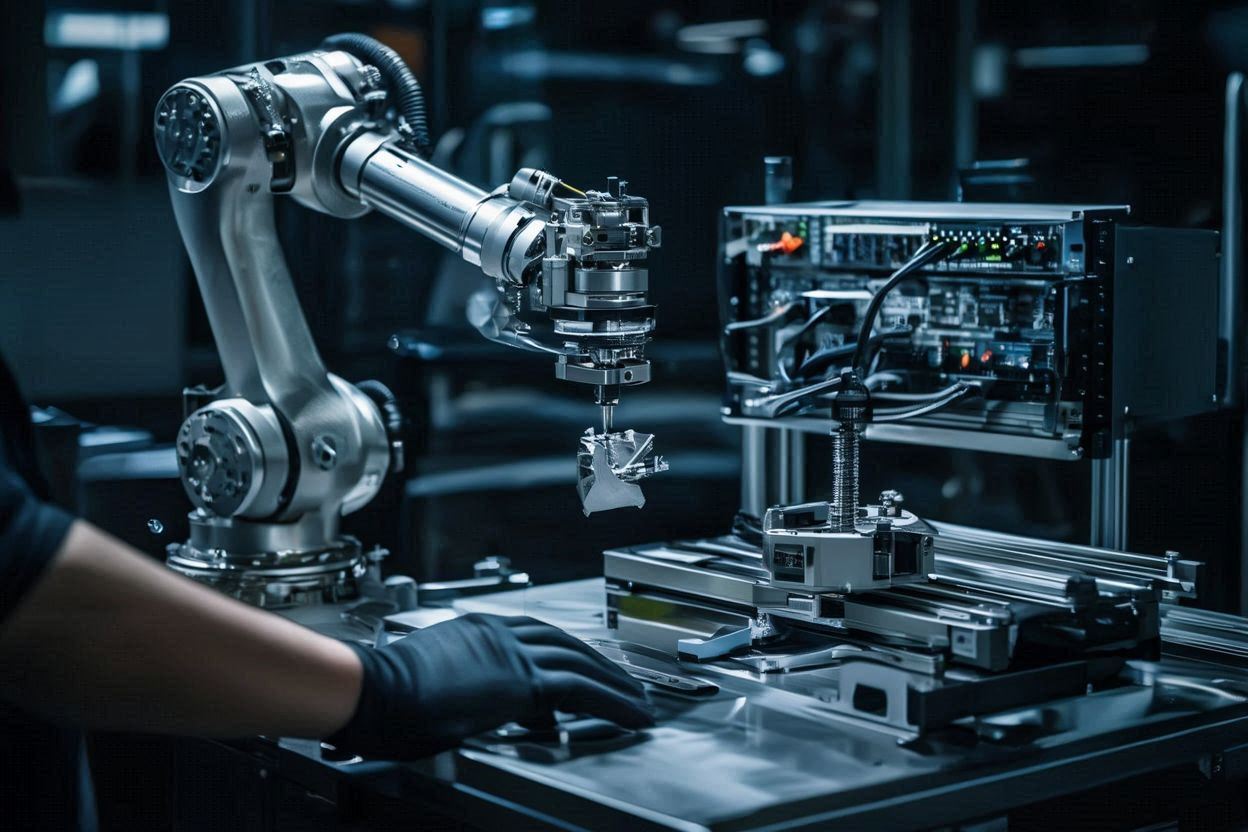
Advanced Motion & Robotics
Motion control and industrial robotics play a critical role in maintaining efficiency, consistency, and innovation across modern manufacturing environments. As production demands increase and product lifecycles shorten, manufacturers require flexible systems that can adapt without compromising reliability or quality.
Advanced motion solutions enable precise control of machines, robots, and coordinated multi-axis systems. By integrating motion, robotics, safety, and data into a unified control architecture, manufacturers gain better visibility into operations and reduce complexity across production lines.
From single-axis applications to highly synchronized robotic cells, intelligent automation allows equipment to operate at optimal performance levels. This results in higher throughput, reduced mechanical wear, and improved repeatability in demanding industrial environments.
Scalable automation platforms support rapid production changes and product variants, allowing manufacturers to introduce new models or technologies without extensive reengineering. This flexibility directly supports profitability, faster ramp-up times, and long-term operational resilience.
Data-driven motion systems provide actionable insights by collecting and analyzing performance metrics in real time. Manufacturers can detect inefficiencies early, optimize energy usage, and implement predictive maintenance strategies that reduce unplanned downtime.
Intuitive control interfaces combined with integrated safety functions empower operational teams to work more efficiently while maintaining strict safety standards. Automated safety responses and simplified system interaction reduce human error and support safer working conditions.
Key Applications of Automation
Automation technologies support a wide range of production processes across automotive and related industries:
- High-precision assembly operations with synchronized robotic motion
- Automated welding processes ensuring consistent joint quality
- Robotic painting and coating for uniform application and reduced waste
- Vision-guided installation of glass and structural components
- Tire and wheel assembly with automated inspection and balancing
- Electric vehicle battery production with scalable robotic handling
Operational Impact Across the Supply Chain
Automation delivers measurable value for established manufacturers, emerging electric vehicle producers, tire manufacturers, and Tier 1 suppliers. Connected production systems enable faster decision-making, improved coordination across facilities, and better alignment with supply chain requirements.
By standardizing automation architectures, organizations can deploy consistent solutions across multiple plants while maintaining the flexibility to address local production needs. This approach supports global scalability without increasing operational complexity.
Performance, Safety, and Long-Term Value
Optimized motion performance across complex production lines Reduced downtime through predictive diagnostics and monitoring Improved product quality through precise and repeatable processes Enhanced worker safety through integrated automation and control Future-ready systems aligned with Industry 4.0 principles
Sustainable and Future-Oriented Manufacturing
Modern automation contributes to sustainability by minimizing energy consumption, reducing material waste, and improving overall equipment efficiency. Intelligent motion control enables manufacturers to achieve environmental goals while maintaining high productivity and cost efficiency.
By investing in flexible, data-enabled automation solutions, manufacturers position themselves for long-term success in an increasingly competitive and technology-driven market.
See how our solutions can optimize your workflows, enhance productivity, and achieve measurable results.